Kitchen Knife Buying Guide: Which Knife Do You Actually Need?
Do you actually need a full knife set?
A good handful of people find themselves with knife blocks filled with fancy knives they rarely touch. Unless your a private chef with a demanding customer, odds are, you don’t need a huge knife block.
So now begs the question: what kind of knife do you actually need?
With detailed explanations of the top most common types of knives currently out in the market, you’re guaranteed to find the answer in this article.
The CHEF’S knife:
WHY IT’S WORTH CONSIDERING: A chef’s knife is the most versatile knife in most kitchens. You’re able to easily chop vegetables, slice meat, dice onions, mince herbs and preparing many everyday ingredients. For most home cooks, this is the first knife worth investing in.
WHAT MAKES IT DIFFERENT: It’s the versatility mentioned above that makes this knife different from the others. It is more versatile than a paring or utility knife, and easier to use for general preparation compared to a specialized knife.
BEST FOR: Chopping, mincing, slicing, dicing, and cutting most ingredients.
SOMETHING TO KEEP IN MIND: Though a chef’s knife is an extremely useful choice for most, carrying out tasks that require a bit more of a specialized knife(such as some cheeses, tomatoes, or bread and pastries) may see the need of a couple other varieties of knives.
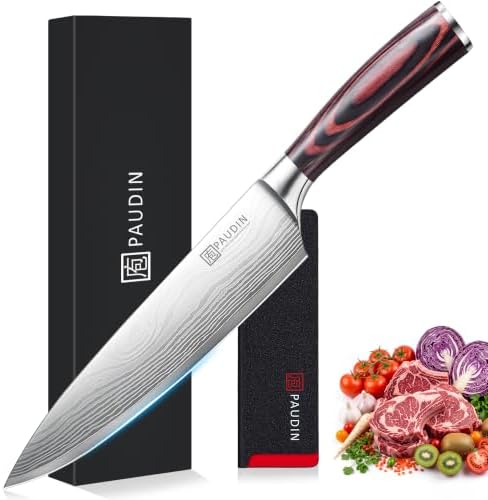
- Premium Rust-Resistant Steel – Each chef knife is crafted from high carbon German stainless steel with 16-18% chrome and 0.6-0.75% carbon, delivering exceptional rust resistance and wear resistance. The blade maintains high rigidity and strength, ensuring long-lasting performance you can rely on meal after meal. Unlike cheaper knives that stain or corrode after a few weeks, this one stays sharp and looks great – even with regular dishwasher use.
- One Knife, Countless Tasks – This 8-inch chef knife handles virtually everything in your kitchen – chopping, slicing, mincing and dicing fruits, vegetables, herbs, and a wide range of meats including fish, chicken and beef. It’s the all-in-one cooking knife that replaces half a drawer of mediocre blades, saving you both money and counter space.
- Precision Performance – Featuring a 2mm thick blade with a 12–14° V-shaped double-beveled edge, this kitchen knife delivers precise, effortless cuts every time. Hand-polished by craftsmen with decades of experience, the edge is built for longevity – no need to sharpen every single day. The blade is perfectly balanced, giving you confidence whether you’re tackling a mountain of greens or breaking down meat.
The SANTOKU knife:
WHY IT’S WORTH CONSIDERING: A Santoku knife is a versatile Japanese-style knife that is particularly useful for chopping, slicing and preparing. The blade of a Santoku is usually wider and higher than a Chef’s knife, which allows for the user to keep their knuckles from coming into contact with a cutting board. Its wide blade can also make it helpful when transferring chopped ingredients from the chopping board to a pan.
WHAT MAKES IT DIFFERENT: Santoku means ‘three virtues’ in Japanese, with it’s three virtues being its ability to cut fish, meat, and vegetables. Usually measuring around 7 inches(almost 18cm) in length, the belly of the knife is ‘flatter’ than that of a chef’s knife, which means it is more comfortably used in an up and down motion rather than a ‘rocking’ motion.
BEST FOR: Fish, meat, and vegetables.
SOMETHING TO KEEP IN MIND: A Santoku knife is not automatically better than a chef’s knife. The best option depends on your preferred cutting style and how the knife feels in your hand. Its flatter edge may be less suitable for cooks who prefer a rocking motion when chopping. However, in my humble opinion, it has a bit more swag than the chef’s knife.

- Japanese High Carbon Steel 10Cr15Mov with HRC62 Santoku Knife
- 5-Layer Laminated Chef Knife Blade Structure Resists Rust and Chipping
- 12° Ultra Sharp Hand Forged Cutting Edge Professional 7-inch Kitchen Knife
The PARING knife:
WHY IT’S WORTH CONSIDERING: A paring knife is a small, precise knife that is useful for tasks that would be awkward with a large chef’s knife. It is ideal for peeling, trimming and preparing smaller ingredients.
WHAT MAKES IT DIFFERENT: Its short blade gives you more control for detailed work and a bigger sense of safety. Instead of splitting baby tomatoes or small fruits with a giant knife and risking cutting your hand, the lightweight paring knife is much easier to handle compared to a chef’s knife in situations like this. Unlike a chef’s knife, it is designed for precision rather than cutting large quantities of food.
BEST FOR: Peeling fruit and vegetables, removing seeds, trimming ingredients, cutting small fruits and vegetables, and preparing garnishes.
SOMETHING TO KEEP IN MIND: A paring knife is not designed for cutting through large or hard ingredients. Avoid using it to cut bones, frozen food or anything that requires excessive force, as this can damage the blade or cause the knife to slip.

- ✅ CONTEMPORARY SYRACUSE DESIGN: Taylors Eye Witness have been designing and creating knives for over 150 years. This experience is shown in the handmade craftsmanship of this range of knives. The sleek well weighted knife comes with a soft, Matte Black rubberised handle which will give a grip like no other. These unique knives would suit both contemporary dining and traditional farmhouse kitchen alike and would be a talking point with family, friends and dinner guests.
- ✅ PRECISION CONTROL: Featuring a medium length blade for enhanced accuracy, precision and speed. Truly a multi-functional vegetable and fruit knife. It is perfect for crunching through the tough crust of bread or using its jagged teeth to smoothly slice through the delicate skin of tomatoes or grapes to leave a smooth, flat finish. It’s also versatile enough for bigger jobs like dicing an onion, removing seeds from chilli peppers or jalapeños or slicing mangos or avocados.
- ✅ 25 YEAR GUARANTEE: At Taylor’s Eye Witness, we are so proud of our products that we guarantee the tools in the Syracuse Range for 25 Years. If in the unlikely event that your knife becomes defective under normal kitchen use and following care instructions provided, it will be repaired or replaced without charge. Best used on wooden or plastic chopping board/surface. Dishwasher safe, but hand wash recommended to extend the knives life.
The SERRATED knife:
WHY IT’S WORTH CONSIDERING: Serrated knives are used instead of a straight edge knife, such as a chef’s knife or santoku, as the serrated edge has a much better ability to bite into food that is either too hard (e.g. bread) or too soft (e.g. tomatoes) than a straight edged knife.
WHAT MAKES IT DIFFERENT: One big difference you’ll notice when you get a serrated knife is that you don’t have to apply much downward pressure when cutting, as the serrations cut through the hard work for you. As the serrations dig into the food, the knife moves downward on each sawing stroke until it’s all the way through. This stops food getting squashed or out of shape while cutting it.
BEST FOR: Tomatoes, soft fruit, cakes, pastries, crusty foods and other ingredients with a firmer outside and softer centre.
SOMETHING TO KEEP IN MIND: A serrated knife is not a replacement for a chef’s knife. It is designed for specific cutting tasks and can be more difficult to sharpen at home because of its toothed edge.
- ✅ CONTEMPORARY SYRACUSE DESIGN: Taylors Eye Witness have been designing and creating knives for over 150 years. This experience is shown in the handmade craftsmanship of this range of knives. The sleek well weighted knife comes with a soft, Matte Black rubberised handle which will give a grip like no other. These unique knives would suit both contemporary dining and traditional farmhouse kitchen alike and would be a talking point with family, friends and dinner guests.
- ✅ PRECISION CONTROL: Featuring a medium length blade for enhanced accuracy, precision and speed. Truly a multi-functional vegetable and fruit knife. It is perfect for crunching through the tough crust of bread or using its jagged teeth to smoothly slice through the delicate skin of tomatoes or grapes to leave a smooth, flat finish. It’s also versatile enough for bigger jobs like dicing an onion, removing seeds from chilli peppers or jalapeños or slicing mangos or avocados.
- ✅ 25 YEAR GUARANTEE: At Taylor’s Eye Witness, we are so proud of our products that we guarantee the tools in the Syracuse Range for 25 Years. If in the unlikely event that your knife becomes defective under normal kitchen use and following care instructions provided, it will be repaired or replaced without charge. Best used on wooden or plastic chopping board/surface. Dishwasher safe, but hand wash recommended to extend the knives life.
The UTILITY knife:
WHY IT’S WORTH CONSIDERING: A utility knife has a pointed and slim blade. A utility knife sits between a chef’s knife and a paring knife in size. It is useful when a paring knife is too small but a chef’s knife feels unnecessarily large.
WHAT MAKES IT DIFFERENT: Its medium-sized blade makes it convenient for smaller preparation tasks. It can be easier to handle when cutting individual portions or ingredients that do not require a large blade.
BEST FOR: Sandwiches, small vegetables, fruit, cheese, cooked meat and everyday cutting tasks. This is often the knife I reach for when in doubt for size.
SOMETHING TO KEEP IN MIND: A utility knife can be extremely convenient, but it is not essential for every kitchen. If you already own a chef’s knife and a paring knife, you may find that they cover most of the tasks a utility knife would perform(though you might find yourself wishing for that sweet middle-ground size while using the other two sizes). .

- Self-sharpening technology: MasterClass’s EdgeKeeper technology keeps this utility knife razor sharp for precision cutting
- High sharpness retention: The small knife blade is made of high-carbon stainless steel, for long-lasting durability
- Cut with confidence: Enjoy total control over this vegetable knife as you cut, slice and dice, thanks to its balanced, ergonomic handle
The BREAD knife:
WHY IT’S WORTH CONSIDERING: The bread knife is a highly-specialized type of serrated knife designed for slicing bread. The length of the knife lets you slice the entire loaf in one smooth motion.
WHAT MAKES IT DIFFERENT: Bread knives are designed for slicing different types of bread, with the sharp points of the serrations cutting through the hard outer crust as found on baguettes. There will be fewer crumbs, and the bread won’t get smushed as its being cut.
BEST FOR: Bread, large pastries
SOMETHING TO KEEP IN MIND: A bread knife is a specialised tool, so it may not be necessary if you rarely eat or prepare bread
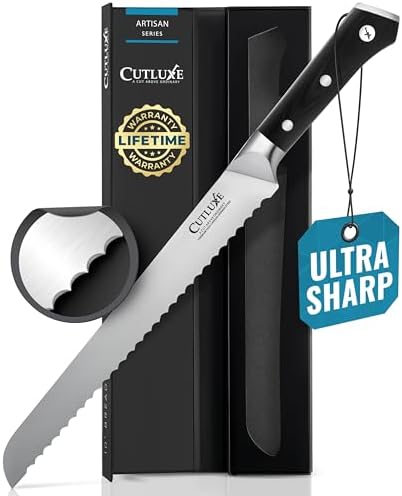
- PREMIUM PERFORMANCE – Perfectly engineered serrated bread knife tapered to a razor-sharp edge for effortless slicing thick breads, toasts, bagels, baguettes, brioche, cakes and more.
- RAZOR-SHARP SERRATED BLADE EDGE – Hand sharpened edge at 14-16 degrees per side for maximum sharpness & edge retention ensuring precision slicing and minimal crumb dispersion when cutting bread.
- FULL TANG ERGONOMIC DESIGN – Luxury pakkawood handle that is triple-riveted for sure grip and absolute stability that ensures comfort and maneuverability. Laminated and polished for a sanitary build, perfect for busy kitchens.
The BONING knife:
WHY IT’S WORTH CONSIDERING: A boning knife is designed to separate meat, poultry or fish from bones. It can be useful for people who regularly buy larger cuts of meat or prepare whole fish at home.
WHAT MAKES IT DIFFERENT: The boning knife has a narrow blade that gives you more precision around bones and joints. Some boning knives are flexible, while others are stiffer. A flexible blade is often useful for fish, whereas a stiffer blade can be helpful for meat and poultry.
BEST FOR: Removing and trimming meat. Preparing poultry and filleting certain types of fish.
SOMETHING TO KEEP IN MIND: It is a specialized knife, so it should only be considered if you regularly need to cut around bones or prepare larger cuts of meat.

- 【Premium High Carbon Steel】This professional fish fillet knife is made from high-quality Japanese stainless steel 10Cr15CoMoV, which makes the HOSHANHO fillet knife more durable, harder, and sharper than other meat knives. With a hand polished edge at 15 degrees per side, the boning knife can achieves ultimate sharpness.
- 【Excellent Cutting Results】With a 7 inch long, thin blade, the fillet knife makes it easy to slice, bone, trim, skin and butterfly different types of meat and fish. The slender blade helps to cut through fish bones and flesh with more precision and less waste, resulting in a neat and beautifully cut fillet.
- 【Ergonomic Design】The ergonomic shape of the fish knife’s handle provides a more comfortable grip and reduces user fatigue. The handle of the boning knife is made of durable pakkawood, these materials have good resistance to corrosion and abrasion, which ensures a long service life of the fillet knife.